Lane & Associates Family Dentistry - Pinehurst Pinehurst, Nc

In route transport, a lane is part of a roadway that is designated to be used by a single line of vehicles to control and guide drivers and reduce traffic conflicts.[one] Virtually public roads (highways) have at least two lanes, one for traffic in each management, separated past lane markings. On multilane roadways and busier two-lane roads, lanes are designated with route surface markings. Major highways frequently have two multi-lane roadways separated by a median.
Some roads and bridges that behave very low volumes of traffic are less than 4.6 metres (15 ft) wide, and are only a single lane broad. Vehicles travelling in reverse directions must boring or cease to laissez passer each other. In rural areas, these are frequently called country lanes. In urban areas, alleys are often only one lane wide. Urban and suburban 1 lane roads are ofttimes designated for ane-way traffic.
History [edit]
For much of homo history, roads did not need lane markings because near people walked or rode horses at relatively deadening speeds. However, when automobiles, trucks, and buses came into widespread use during the commencement two decades of the 20th century, head-on collisions became more than common.
The history of lane markings is connected to early mass automobile construction in Detroit. In 1906, the outset Road Commission of Wayne County, Michigan was formed in an effort to make roads safer. (Henry Ford served on the board in the first year.)[2] In 1909, the commission ordered the structure of the first concrete road (Woodard Avenue in Detroit), and conceived the centerline for highways in 1911. Hence, then chairman of the Road Commission, Edward N. Hines, is widely credited every bit the inventor of lane markings.[3]
The introduction of lane markings equally a mutual standard is connected to June McCarroll, a physician in Indio, California. She began experimenting with painting lines on roads in 1917 afterward being run off a highway by a truck driver. After years of lobbying past Dr. McCarroll and her allies, the country of California officially adopted a policy of painting lines on its highways in November 1924. A portion of Interstate 10 near Indio has been named the Dr. June McCarroll Memorial Expressway in her honor.

Black heart line on an Autobahn in Germany in the late 1930s
The first lane markings in Europe were painted at an accident hotspot in the pocket-size town of Sutton Coldfield near Birmingham, England, in 1921. The success of this experiment made its fashion to other hotspots and led to standardization of white paint lane markings throughout Dandy Britain.[4]
The get-go use in Germany was in Berlin in 1925, where white pigment marked both lanes and road edges. When the standard for the new autobahn network was conceived in the 1930s, it mandated the usage of blackness paint for the center line for each carriageway. Blackness is more visible on the bright surface of concrete.
Past 1939, lane markings had become then popular that they were officially standardized throughout the Us. The concept of lane markings spread throughout the globe and became standard for well-nigh roads. Originally, lines were drawn manually with ordinary pigment which faded chop-chop. Subsequently World War Two, the first machines for line markings were invented.[5] Plastic strips became standard in the 1950s. This gradually led to the placement of plastic lane markings on all major roads.
Types [edit]

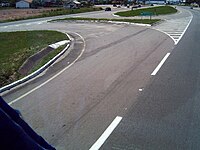
Turning lane on the Rodovia BR-101, Brazil

Special, wide two-lane road used at some stretches in Aura, Finland

Transfer lanes, connecting surface collector lanes with through lanes between two tunnels
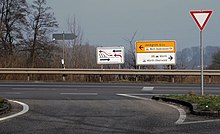
- A traffic lane or travel lane is a lane for the movement of vehicles travelling from 1 destination to another, not including shoulders.
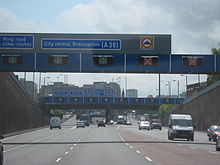
The A38(M) Aston Superhighway, showing tidal menstruum/reversible lanes controlled via overhead gantries, in Aston, Birmingham, England. This pike has seven lanes, with the i lane always kept as a buffer in the center – in the morning peak time, there are ii lanes leaving central Birmingham (northbound) and 4 lanes in (southbound). In the evening, there are iv lanes leaving cardinal Birmingham and 2 lanes coming inwards. At all other times there are iii lanes on each side.
- A through lane or thru lane is a traffic lane for through traffic. At intersections, these may exist indicated by arrows on the pavement pointing straight ahead.
- An express lane of a road is used for faster moving traffic and has less access to exits/off ramps. In other areas, an express lane may refer to a HOV lane (run into below).
- A reversible lane (contraflow lane) is a lane where the direction of traffic can be changed to match the peak menstruum. They are used to adjust periods of high traffic catamenia, specially rush hour where the catamenia is predominantly in one direction, on roads that cannot exist easily widened such as over bridges. I or more than lanes are removed from the opposing catamenia and added to the peak flow – this technique is known as tidal flow.
- An auxiliary lane is a lane other than a through lane, used to split entering, exiting or turning traffic from the through traffic.
-
- An acceleration lane or merge lane allows traffic entering a highway to accelerate to the speed of through traffic earlier merging with it.
- A deceleration lane is a lane adjacent to the primary road or street used to improve traffic safety by allowing drivers to pull out of the through lane and decelerate safely before turning off a surface street or exiting a highway or freeway.
- A turn lane is prepare aside for slowing downwards and making a plow, so as not to disrupt traffic. By removing turning traffic from the through lanes, motorist rubber is improved and delay is removed, but crossing distances for pedestrians are lengthened, increasing their exposure to collisions.
- A two-fashion center turn lane is a lane in the middle of a roadway to allow drivers travelling in either direction to pause before turning across oncoming traffic (a left turn in correct-driving countries, or a right turn in left-driving countries) while waiting for a gap in traffic.
- A passing lane is sometimes provided on busy ii-lane roads to allow drivers to laissez passer slower vehicles without having to cross the middle line and risking a head-on collision.
- A crawler lane, truck lane, or climbing lane is ofttimes provided on steep colina or mountain grades, in order to let smaller vehicles to laissez passer larger, slower ones. The lane is marked only on the uphill stretch and ordinarily a short altitude later (for regaining speed).
- An operational lane or auxiliary lane is an actress lane on the entire length of highway between interchanges, giving drivers more time to merge in or out. The lane is created when an entrance ramp meets the highway, and drops out (with an "exit merely" sign) to become the ramp at the next go out.[half dozen]
- A transfer lane of a road is used to movement from express lanes to collector lanes, or vice versa; it is somewhat like to an auxiliary lane.
- A collector lane of a route is used for slower moving traffic and has more access to exits/off ramps.
- Defended lanes are traffic lanes fix aside for particular types of vehicles.
-
- A high occupancy vehicle, 2+ lane or carpool lane is reserved for carpooling. In the U.k., such lanes are non extremely common, although they do be in many places—they are ordinarily marked "ii+ LANE", referring to the fact that cars with two or more occupants may bulldoze in the lane. In the US, they may be marked with a diamond icon every few hundred anxiety (hence the nickname "diamond lane"), or separated from other lanes by double broken white lines, a continuous pair of double yellow lines, or only a single cleaved white line.
- A high-occupancy toll lane is a combination of an HOV lane and cost collection technology that allows drivers without passengers to use the HOV lane past paying a premium price for the privilege
- A designated bicycle lane is a portion of the roadway or shoulder designated for the exclusive or preferential use of bicyclists. This designation is indicated by special word or symbol markings on the pavement and "Cycle LANE" signs.
- A motorcycle lane is provided at certain roads and highways such equally the Federal Highway in Malaysia to segregate the motorbike traffic from the main roadways to reduce motorbike-related accidents. The motorcycle lane may course a part of the difficult shoulder, or may be one or more than completely separated lanes.
- A bus lane is reserved for buses providing public transportation on a stock-still road, sometimes with overhead catenary for trolleybuses. In some countries, such as in the UK when signposted, bus lanes may also be used by some other traffic, such as taxis, bicycles and motorbikes.
- A tram lane is a lane reserved for the employ of buses, trams and taxicabs. It is usually encountered in cities with curbside tram network, such equally Zagreb.
- A truckway is a defended lane for longer length trucks; for case, the Florida Turnpike allows 96-pes long double trailer combinations,[7] in contrast to normal Florida highways' 53-foot limit. Compare to crawler lane above.[viii] Since the major toll of trucking is the fixed cost of the aforementioned trailer with its driver the cost per ton of operating with truckway size and weight allowances is 35 to xl percent below the cost of operations on the non-truckways.[9]
- In some areas, the lane adjacent to the curb is reserved for non-moving vehicles.
-
- A parking lane is reserved for parallel parking of vehicles.
- A fire lane is the area next to a curb, which is reserved for firefighting equipment, ambulances, or other emergency vehicles. Parking in these areas, oftentimes marked by red lines, usually warrants a parking ticket.
- A loading lane (loading zone in the United states of america) is an area next to a curb, which is reserved for loading and unloading passengers or freight. It may be marked by a sign ("LOADING But" or "LOADING ZONE") or by a yellow or white-painted curb.
- A hard shoulder is sometimes called an emergency lane or a breakup lane, when it is reserved for vehicle breakdowns, and for emergency vehicles. On some congested roads, the shoulder is used every bit a vehicle lane during peak travel hours.
- Past law or custom, outside (British usage of the word) lanes are oftentimes reserved for faster traffic, and inside lanes are used by slower traffic.[ citation needed ]
-
- An overtaking lane is the lane furthest from the shoulder of a multi-lane carriageway/roadway (sometimes chosen the fast lane, although this is deprecated past the authorities), i.eastward. the leftmost lane where traffic drives on the right, or the rightmost lane where traffic drives in the left.
- The slow lane is the lane nearest to the shoulder of a multi-lane carriageway/roadway, i.eastward. the farthest from the overtaking lane.
- These usages lead to the phrases life in the slow lane and life in the fast lane, used to depict relaxed or busy lifestyles, respectively and used equally the titles of various books and songs.
Lane width [edit]

Assumed widths and heights in road design (in meters)
The widths of vehicle lanes typically vary from 2.7 to 4.6 thou (nine to fifteen ft). Lane widths are commonly narrower on low volume roads and wider on higher volume roads. The lane width depends on the assumed maximum vehicle width, with an additional space to allow for lateral motion of the vehicle.[ commendation needed ]
In the United States, the maximum truck width had been 8 ft (2.4 1000) in the Code of Federal Regulations of 1956, which exactly matched then standard shipping container width. The maximum truck width was increased in 1976 to 102 in (ii.59 grand) to harmonize with the slightly larger metric two.half-dozen thou (102.4 in) world standard width.[x] The same applies to standards in Europe, which increased the commanded width of route vehicles to a electric current maximum of two.55 yard (100.4 in) for nearly trucks, and two.vi yard (102.four in) for refrigerator trucks. These widths do non include side mirrors, but simply the vehicle body. The minimum extra space had been 0.xx m (vii.9 in) and it is currently causeless to exist at to the lowest degree 0.25 m (nine.8 in) on each side. The international standard allows roads with less traffic to add a second or 3rd lower width lane in the same management for cars 1.75 m (69 in) – those that have been built exclude trucks from these narrower lanes; however lower width lanes are not a recommended design principle for new roads, equally information technology could be dangerous if traffic becomes heavier in future.
In the Us, the Interstate Highway standards for the Interstate Highway System use a 12 ft (3.vii m) standard lane width, while narrower lanes are used on lower classification roads. In Europe, laws and road widths vary by country; the minimum widths of lanes are generally between ii.5 to 3.25 thousand (8.2 to 10.7 ft).[eleven] The federal Bundesstraße interurban network in Germany defines a minimum of 3.five m (140 in) for each lane for the smallest two lane roads, with an boosted 0.25 m (9.8 in) on the outer sides and shoulders being at least ane.5 m (59 in) on each side. A modern Autobahn divided highway with 2 lanes per direction has lanes three.75 thousand (12.3 ft) wide with an additional clearance of 0.50 thousand (20 in) on each side; with three lanes per direction this becomes 3.75 grand (12.3 ft) for the rightmost lane and 3.5 m (xi ft) for the other lanes. Urban access roads and roads in low-density areas may have lanes as narrow as 2.50 k (eight.ii ft) in width per lane, occasionally with shoulders roughly 1 one thousand (39 in) wide.[12]
[edit]
Depending on speed, road curvature and vehicle properties, heavy goods vehicle (HGV) combinations are prone to "high speed exterior offtracking". This means that the rearmost axle of the trailer does not follow the lateral path of the truck tractor unit, but may travel significantly—upwards to 1–3 meters (three–10 ft)—away from the curve eye. Hence, narrow lanes on sharp curves accept to be designed slightly wider than on straight roads. This effect is much greater on glace snow-covered roads than on bare asphalt or cement physical, calling for fifty-fifty larger lane widening.[ citation needed ]
Effects of lane width [edit]
In full general, wider lanes are associated with a reduction in crashes,[ commendation needed ] merely in urban settings both narrow (less than ii.8 m (9.2 ft)) and wide (over 3.1~3.ii m (10.2-x.5 ft)) lanes increase crash risks.[thirteen] Wider lanes (over 3.3~3.4m (x.8-11.ii ft)) are associated with 33% higher impact speeds, as well as higher crash rates. Conveying capacity is also maximal at a width of 3.0 to three.1 metres (9.8 to x.2 ft), both for motor traffic and for bicycles. Pedestrian volume declines every bit lanes widen, and intersections with narrower lanes provide the highest chapters for bicycles.[thirteen] As lane width decreases, traffic speed diminishes.[fourteen] Some new urbanists argue that safe and chapters are non adversely impacted past reducing lane widths to as little as 10 ft (3.0 1000).[15]
Lane markings [edit]

A typical rural American freeway (Interstate 5 in the Central Valley of California). The yellow line is on the left, the dashed white line in the middle, and the solid white line on the right. The rumble strip is to the left of the xanthous line.
Painted lane markings, which designate a single line of vehicles for motility inside traffic, vary widely from country to country. In the United States, Canada, Mexico, Honduras, Puerto Rico, Virgin Islands and Norway, yellow lines separate traffic going in opposite directions and white separates lanes of traffic traveling in the same direction; but that is non the case in many European countries.
Lane markings are mostly lines painted on the road by a road mark car, which can adapt the marking widths co-ordinate to the lane blazon.[xvi]
Lane numbering [edit]
Traffic reports in California often refer to accidents being "in the number X lane." The California Department of Transportation (Caltrans) assigns the numbers from left to right.[17] The far left passing lane is the number 1 lane. The number of the irksome lane (closest to freeway onramps/offramps) depends on the full number of lanes, and could be anywhere from 2 to 8.
However in the UK, "lane 1" is the "deadening lane" (left-hand lane).
Capacity [edit]
Lane capacity varies widely due to atmospheric condition such as neighboring lanes, lane width, elements next to the road, number of driveways, presence of parking, speed limits, number of heavy vehicles and and then on – the range can be equally low equally one thousand passenger cars / hour to every bit high equally 4800 passenger cars / hour simply mostly falls betwixt 1500 and 2400 rider cars / 60 minutes.[18]
Run across also [edit]
- Country lane
- Green lane (road)
- Lane departure warning system
- Lane splitting
- Left- and correct-hand traffic
- Route surface
- Road surface marker
- Route marking machine
- Shoulder (road)
References [edit]
- ^ "Lane – Definition and More from the Free Merriam-Webster Dictionary". merriam-webster.com. Archived from the original on Feb iv, 2015.
- ^ "Home – Public Services". www.waynecounty.com. Archived from the original on April 14, 2015. Retrieved May v, 2018.
- ^ "MDOT – Hines, Edward Due north. (1870–1938)". world wide web.michigan.gov. Archived from the original on June 30, 2015. Retrieved May 5, 2018.
- ^ Douglas V. Jones: The Royal Town of Sutton Coldfield – A Commemorative History, Westwood Press 1994, ISBN 0-9502636-7-2.
- ^ Zeitreise der Markierungstechnik
- ^ "Glossary". Kurumi.com. Archived from the original on April 24, 2013. Retrieved June iii, 2013.
- ^ "Rule 14–61 Tandem Trailers on Florida'due south Turnpike". www.floridasturnpike.com. Archived from the original on November 5, 2012. Retrieved Jan 2, 2016.
- ^ "The 2015 Florida Statutes, 316.515(3)(b)2". www.leg.state.fl.the states. Archived from the original on December 10, 2015. Retrieved January two, 2016.
- ^ Samuel, Peter. "The Way Forward to the Private Provision of Public Roads". Street Smart: Competition, Entrepreneurship and the Futurity of Roads. pp. 516–517.
- ^ "Federal Size Regulations for Commercial Motor Vehicles". Archived from the original on September 18, 2015. Retrieved September fourteen, 2015.
- ^ "EuroTest". Eurotestmobility.internet. Archived from the original on March 11, 2012. Retrieved August 8, 2012.
- ^ de:Richtlinien für dice Anlage von Straßen – Querschnitt
- ^ a b Dewan Masud Karim. Narrower Lanes, Safer Streets (Accepted Paper for CITE Briefing Regina, June 2015) "Archived re-create". Archived from the original on September 23, 2016. Retrieved January one, 2016.
{{cite web}}: CS1 maint: archived copy as title (link) accessed January one, 2015 - ^ "Lane Width". Chapter 3: The 13 Controlling Criteria. Us Department of Transportation Federal Highway Assistants. Archived from the original on May thirteen, 2013. Retrieved June 3, 2013.
- ^ "Theo Petrisch, "The Tite about Lane Widths," The Pedestrian and Bicycle Information Center, accessed April 12, 2013". Archived from the original on April five, 2017.
- ^ "how to pigment road marker lines of different widths". Archived from the original on September xi, 2014.
- ^ "Highway Design Manual: Chapter 60: Nomenclature" (PDF). California Department of Transportation. Land of California. Archived (PDF) from the original on March 24, 2012. Retrieved June three, 2013.
- ^ Guide to Traffic Management Part iii: Traffic Studies and Analysis. Austroads. 2013. pp. Department 4.
Source: https://en.wikipedia.org/wiki/Lane
0 Response to "Lane & Associates Family Dentistry - Pinehurst Pinehurst, Nc"
Post a Comment