Median Number of Books Read by Adults Per Year
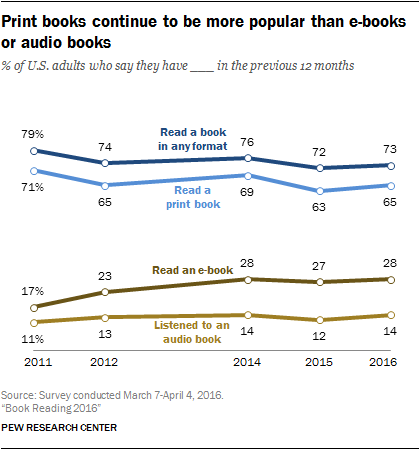 Americans today have an enormous variety of content available to them at any time of day, and this material is available in a number of formats and through a range of digitally connected devices. Nevertheless even as the number of ways people spend their time has expanded, a Pew Research Center survey finds that the share of Americans who have read a book in the terminal 12 months (73%) has remained largely unchanged since 2012. And when people reach for a book, it is much more likely to be a traditional impress book than a digital production. Fully 65% of Americans take read a print volume in the last year, more double the share that has read an due east-volume (28%) and more than four times the share that has consumed volume content via sound book (14%).
Simply while print remains at the centre of the book-reading mural equally a whole, there has been a distinct shift in the e-book landscape over the last five years. Americans increasingly turn to multipurpose devices such as smartphones and tablet computers – rather than defended due east-readers – when they appoint with e-book content. The share of e-volume readers on tablets has more than tripled since 2011 and the number of readers on phones has more than doubled over that time, while the share reading on due east-book reading devices has not changed. And smartphones are playing an especially prominent function in the due east-reading habits of sure demographic groups, such as non-whites and those who have not attended college.
These are amidst the main findings of a nationally representative telephone survey of 1,520 American adults conducted March 7-Apr 4, 2016.
The share of Americans who have read a volume in the last year is largely unchanged since 2012; more Americans read impress books than either read east-books or mind to audio books
Following a slight overall decline in book readership between 2011 and 2012, the share of American adults who read books in any format has remained largely unchanged over the concluding four years. Some 73% of Americans study that they have read at least one book in the concluding twelvemonth. That is almost identical to the 74% who reported doing then in a survey conducted in 2012, although lower than the 79% who reported doing and then in 2011.
Americans read an average (mean) of 12 books per twelvemonth, while the typical (median) American has read 4 books in the final 12 months. Each of these figures is largely unchanged since 2011, when Pew Research Center showtime began conducting surveys of Americans' volume reading habits (for additional details on the number of books read per year past different demographic groups, see Appendix A).
Readers today can access books in several mutual digital formats, simply print books remain essentially more popular than either e-books or audio books. Roughly two-thirds of Americans (65%) have read a print book in the terminal yr, which is identical to the share of Americans who reported doing so in 2012 (although downward slightly from the 71% who reported reading a print book in 2011).
By contrast, 28% of Americans take read an due east-book – and xiv% accept listened to an sound volume – in the last year. In addition to being less popular than print books overall, the share of Americans who read e-books or heed to audio books has remained fairly stable in recent years.
E-volume readership increased by 11-percentage points between 2011 and 2014 (from 17% to 28%) only has seen no modify in the last two years. Similarly, the share of American adults who listen to sound books has changed only marginally since Pew Research Heart first asked nearly this topic in 2011 – at that signal, 11% of Americans had listened to an audio book in the concluding year, compared with 14% now.
Nigh four-in-ten Americans read impress books exclusively; just 6% are digital-only book readers
In total, 34% of Americans have either read an e-book or listened to an audio book in the last year, merely relatively few Americans read books in these digital formats to the exclusion of print books.
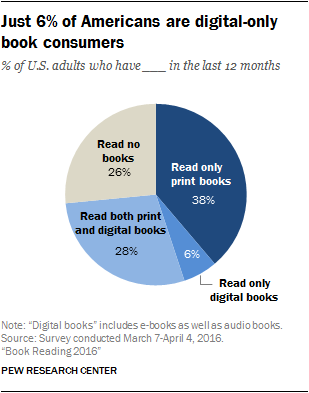 More than one-quarter (28%) of Americans read books in both print and digital formats (which includes e-books and audio books). Some 38% read impress books only did not read books in whatsoever digital formats, while simply 6% read digital books but not print books.
Relatively few Americans are "digital-simply" volume readers regardless of their demographic characteristics. However, some demographic groups are slightly more likely than others to practice all of their reading in digital format. For instance, seven% of college graduates are digital-only volume readers (compared with just 3% of those who accept not graduated from high school), equally are eight% of those with almanac household incomes of $75,000 or more (compared with iii% of Americans with incomes of $30,000 or less). Interestingly, young adults are no more likely than older adults to be "digital-simply" book readers: 6% of eighteen- to 29-twelvemonth-olds read books in digital formats only, compared with 7% of xxx- to 49-twelvemonth-olds and 5% of those 50 and older.
Higher graduates are roughly four times every bit likely to read e-books and about twice every bit likely to read print books and audio books – compared with those who take not graduated loftier school
 Equally was the example in previous Pew Research Center surveys on volume reading, certain groups of Americans read at relatively high rates and in a wide multifariousness of formats. These include:
College graduates – Compared with those who have not attended college, higher graduates are more likely to read books in full general, more than probable to read print books, and more than likely to consume digital-book content. The typical (median) higher graduate has read seven books in the last year.
Young adults – 80% of 18- to 29-year-olds have read a book in the last twelvemonth, compared with 67% of those 65 and older. These young adults are more than likely than their elders to read books in diverse digital formats, but are as well more than probable to read impress books as well: 72% have read a impress book in the terminal year, compared with 61% of seniors.one
Women – Women are more probable than men to read books in general and also more likely to read print books. However, men and women are every bit likely to read digital-format books such every bit e-books and sound books.
The share of Americans who read books on tablets or cellphones has increased substantially since 2011, while the share using defended e-readers has remained stable
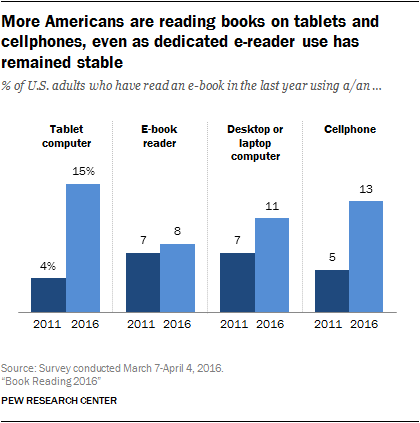 Tablet computer and smartphone ownership accept each increased dramatically in recent years, and a growing share of Americans are using these multipurpose mobile devices – rather than defended east-readers – to read books. Between 2011 and 2016, the number of Americans who read books on tablet computers has increased most fourfold (from four% to 15%), while the share who read books on smartphones has more doubled (from 5% to thirteen%). The share of Americans who read books on desktop or laptop computers has as well increased, although by a more minor amount: 11% of Americans now practise this, up from seven% in 2011.
By dissimilarity, 8% of Americans now written report that they read books using dedicated e-reader devices – nearly identical to the seven% who reported doing then in 2011.
About one-in-five Americans nether the historic period of 50 accept used a cellphone to read e-books; blacks and Americans who have non attended college are especially likely to turn to cellphone – rather than other digital devices – when reading e-books
 Previous Pew Research Center studies have documented how several groups – such as blacks and Latinos, and those who accept not attended college – tend to rely heavily on smartphones for online access. And in the context of book reading, members of these groups are especially likely to plough to smartphones – rather than tablets or other types of digital devices – when they engage with e-volume content.
For instance, 16% of blacks written report that they utilize their cellphones to read books. That is nearly double the share of blacks who read books on traditional computers (9%) and four times the share who read books using dedicated e-readers (4%). Hispanics are less probable than blacks as a whole to read books on cellphones (11% practice so), but Hispanics are also substantially more probable to read books on cellphones than on e-readers or traditional computers. By contrast, whites tend to plough to a range of digital devices when reading e-books: xiii% read eastward-books on cellphones, merely eighteen% read e-books on tablet computers, 10% use e-book readers and 11% engage with e-book content on desktop or laptop computers.
Cellphones too play a relatively prominent role in the reading habits of Americans who have not attended college. College graduates are far more likely than those with high school diplomas or less to read books on tablets (25% vs. 7%), eastward-book readers (xv% vs. 3%) or traditional computers (15% vs. half dozen%). But these differences are much less pronounced when it comes to reading books on cellphones. Some 17% of college graduates read books this way, compared with eleven% of those with loftier school diplomas or less – just a 6-percentage betoken difference.
Along with these groups, Americans nether the age of 50 are particularly likely to consume e-volume content on cell phones: one-in-v (19%) exercise and then, compared with nine% of fifty- to 64-yr-olds and just 4% of those 65 and older.
The share of Americans who read in lodge to inquiry a specific topic of involvement has increased in contempo years
 In add-on to asking whether – and on what devices – Americans read books specifically, the survey also included a broader fix of questions asking virtually reasons that people might read written content of whatever kind (including books, but besides magazines, newspapers or online content).
Among all American adults:
- 84% ever read to research specific topics of interest (29% do and so nearly every twenty-four hour period).
- 82% read to keep up with electric current events (47% nearly every 24-hour interval).
- 80% read for pleasure (35% well-nigh every day).
- 57% read for work or school (31% do and then nearly every day).
A similar share of Americans written report that they read for pleasure, for work or schoolhouse, or to proceed up with current events compared to the most contempo time these questions were asked in 2011. However, the share of Americans who read in lodge to research specific topics of involvement has increased past 10-percentage points over that fourth dimension frame, from 74% to 84%.
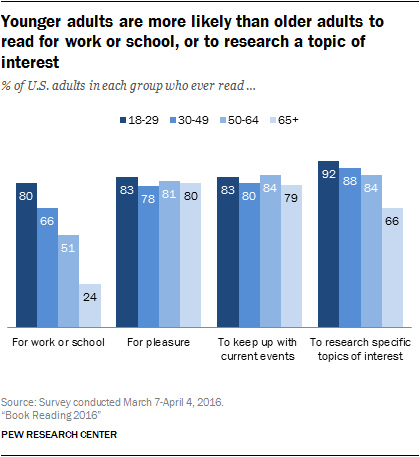
Older and younger adults are equally probable to read for pleasure or to go on upwards with electric current events; younger adults are more likely to read for work or school, or to research a topic of interest
 In some cases, the factors associated with high rates of book readership are the same ones associated with reading for specific purposes. For instance, college graduates are more likely than those who have only attended high schoolhouse to read books in general – and they are also more likely to read for all 4 of the specific motivations examined in this survey.
At the same time, there is not e'er such a directly relationship between book reading and overall reading for specific purposes. As noted earlier in this report, young adults are more than likely to read books than older adults. And when asked almost specific reasons why they might read a range of content, these young adults are much more likely than older adults to say that they read for work or school, or to enquiry a specific topic of interest. However, Americans of all ages are equally likely to point that they read (whether in book form or otherwise) for pleasance or to continue up with current events.
Source: https://www.pewresearch.org/internet/2016/09/01/book-reading-2016/#:~:text=Americans%20read%20an%20average%20(mean,in%20the%20last%2012%20months.
0 Response to "Median Number of Books Read by Adults Per Year"
Post a Comment