Shore to the Mountain and Back Again
Information technology's a typical autumn day in the forests above Northward Vancouver, British Columbia. The rain is coming downward so hard you can't see more than a few hundred anxiety, almost obscuring the cedar copse swaying in the surrounding murk. Wind whips between the column-like trunks, pushing waves through the sea of emerald sword fern. A crack slices through the rain as a pocket-sized tree snaps and falls into a nearby stand of Douglas fir.
If Betty Birrell or her son Hayden Robbins are fazed past the weather, they don't show information technology. Their bikes bladder down a river of contorted roots, greasy rocks and slippery wooden bridges every bit if it'southward a balmy day in June, with Betty leading through the vilest weather condition. It's astonishing to watch. She is much, much more confident on these trails than I will ever be, and I'm one-half her age—and a former professional mountain biker, though I feel embarrassed to admit it at the moment.
At 73 years former, Betty has called these trails domicile for nigh thirty years. In 1994, at the age of 45, she bought her first mount bike, and a skillful friend she refers to only as "Old Rob" took her downwards 7th Secret, a trail on Mount Fromme. Her 2d ride was on the aptly named Executioner, another steep, rooty, technical fall-line descent. Both trails accept retained their black-diamond rating, and fifty-fifty on the plush full-suspension bikes of today, most would find Executioner terrifying.
Her confront lights up at the memory. "I was hooked right away."
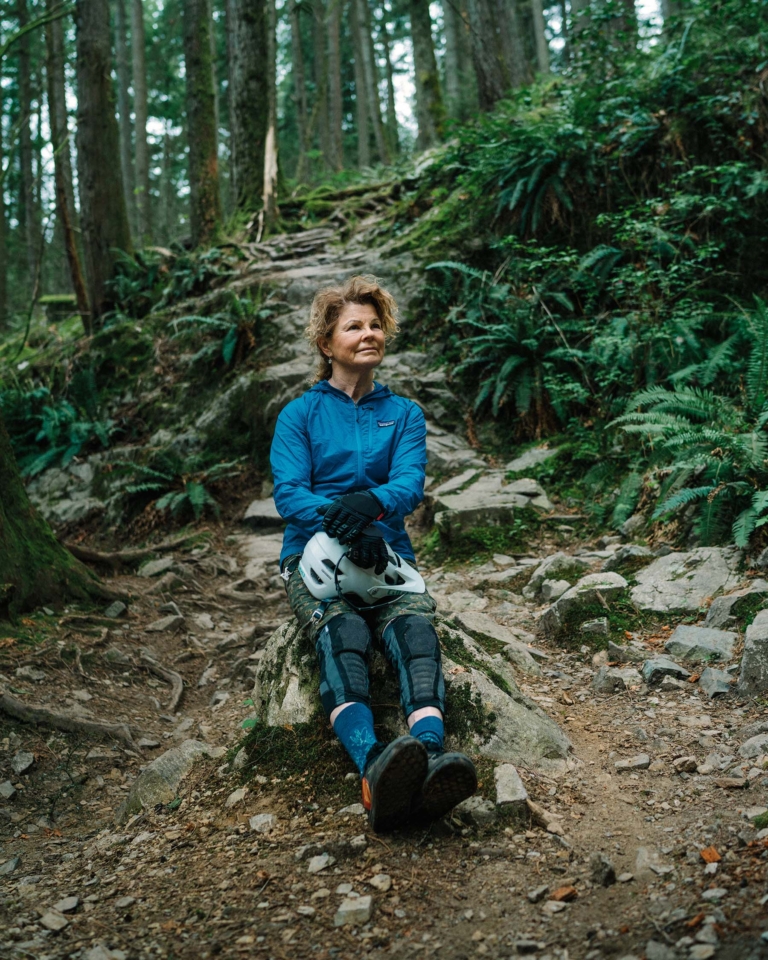
Betty poses at the bottom of Empress, a treacherously steep, extremely technical double-blackness diamond on lower Mount Seymour. Photo: Hashemite kingdom of jordan Manley
Betty's archway into mountain biking—as a unmarried mother a few years short of 50, raising a vi-year-old while flying overseas each weekend every bit an international flight attendant—is unconventional, by any measure. But to starting time on Vancouver'due south North Shore during the 1990s … well, that's another level of gnarly.
Clinging to the mist-shrouded slopes of Mount Fromme, Mountain Seymour and Cypress Mountain above North Vancouver, "The Shore" is to mount biking what Yosemite is to rock climbing or what O'ahu is to surfing: No other place has washed more to influence and define the sport. And, like Pipeline or the Dawn Wall, it is not for the faint of eye.
"Some people say that California invented mountain biking," says local trail architect Todd Fiander. "The North Shore invented mountain biking."
The Shore'due south infamous trails are a cross between a BMX track and an Ewok hamlet, a convoluted web of wooden ladder bridges, stone drops, berms and "skinnies"—narrow, raised features intended to be ridden across. Some of this woodwork climbs into the trees, demanding riders navigate catwalk-like planks, sometimes only six-inches wide and equally high as 20 feet above the forest flooring. Other features roll multiple stories down near-vertical stone faces.
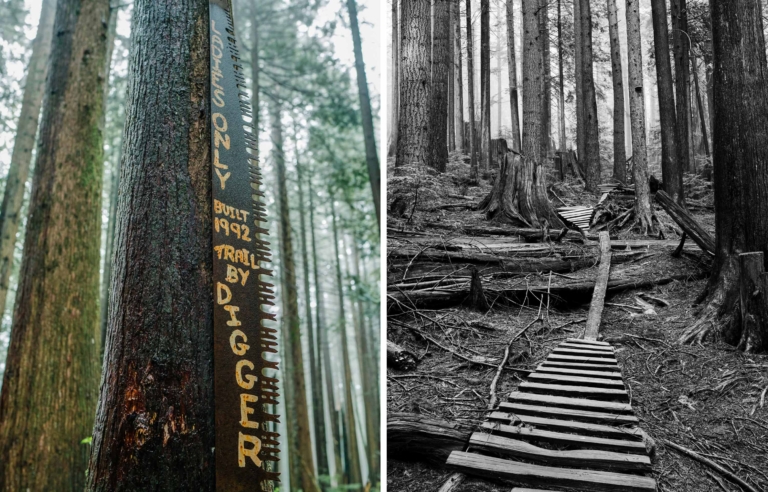
Left: Ladies Only is ane of Todd Fiander'due south most beloved masterpieces, a seminal and lasting attestation to his vision and commitment to giving people a good time. He built it in 1992 and has been personally maintaining and tinkering with it ever since. The trail redefined what was possible, with features like the outset-always teeter-totter span and the iconic "Monster" roller coaster, and though information technology's seen some overhauls over the by 30 years, it still embodies the spirit of those early days. Photo: Jordan Manley
Right: Built by "Unsafe Dan" Cowan, the Flight Circus trail on Mount Fromme represents the cool peak of the N Shore's renegade early years. It had the skinniest, highest and almost dangerous features anyone had e'er seen and could only be ridden by a handful of people. Trails similar Flying Circus were decommissioned equally mountain biking became more than widely adopted, but the remnants speak to the enduring legacy of cedar planks, mad creativity and an unrelentingly desire to push the limits. Photograph: Jordan Manley
"Shore-style" trails can now be found across the earth, simply when Betty started riding in 1994, locals had just been building them for a few years. Todd—or "Digger" as he's known in the mount bike globe—was the first to incorporate ladder bridges and raised wooden structures into his trails. He's observed near every rider on the Shore for the past three decades and captured many in his 11 "North Shore Farthermost" films. Including—to my surprise, and, I must admit, chagrin—Betty.
A few years ago, I fabricated a documentary about the history of freeride mountain biking, much of which happened on Digger'southward trails, yet I hadn't heard of Betty until this past year. I'd seen her, however, while pouring through hours of Digger's grainy camcorder footage. I merely didn't know it was her.
"Betty was the get-go person to ride 'The Monster,'" Digger says, referring to an iconic stunt usually regarded as the first "roller coaster." (It looks exactly as it sounds, just made with slats of split cedar.) "I had just put the last plank down and asked her to ride it for me, so I pulled out my camera and filmed her. The tertiary time, she fell down and pulled out her shoulder, and I had to pop it back in. And I call up she was like 55 when she did that!"
Betty recounts those early days so casually, it takes me a few minutes to realize how insane her entry into the sport was. In the early '90s, body armor wasn't a thing—neither was full-suspension nor hydraulic brakes, making the bikes equally much of a liability as a lack of skill.
"Fortunately, I didn't actually have a fear of falling," she says. "Withal, I was covered with bruises, blackness and bluish. I couldn't get out wearing shorts because it looked like someone took to me with a baseball game bat."
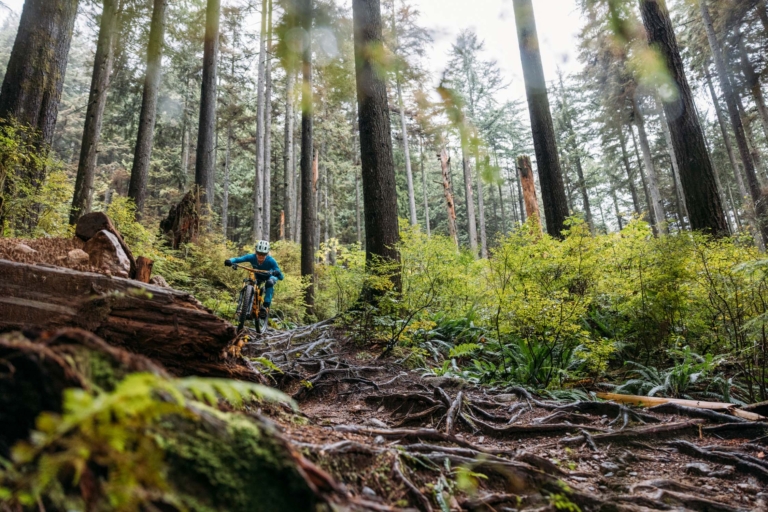
The Due north Shore is well-known for its wooden features and stone rolls, merely what gets most people are all the roots, which go so slippery after a rainstorm that even a slightly misplaced tire can lead to disaster. For Betty, such greasy sections—like upper Floppy Bunny—just add a piffling spice to long-familiar trails. Photo: Travis Rummel
But full-send is how Betty operates, under the radar or not. Born in the rural town of Chemainus, on Vancouver Island, Betty moved to Vancouver to study geography at the University of British Columbia, where she joined a crew of young man students on weekend climbing trips up some of the biggest peaks around Vancouver.
"In the '70s, she was function of this really hard-core group of climbers that had all sorts of first ascents in the expanse," says Hayden, who is a professional ski and mountain guide and operations manager for Whitecap Alpine Adventures. "Merely they wouldn't claim them because they didn't want people to find the zones."
Betty picked up windsurfing a few years later, and past the early on 1980s had become 1 of the peak female windsurfers in the sport, flying out of huge 30-foot waves the likes of which no adult female had washed before. Equally an editor for Sheet Boarder Magazine put it in 1982: "Betty Birrell is a superstar of the sport … a leader of the leading edge … ranked on par with about superlative men." The German language magazine Surf summed it upwards even more succinctly, in a headline from their June 1982 consequence: "Betty Birrell: The best female person surfer in the world."
She stationed herself in Hawaiʻi, working as an international flight bellboy while surfing between shifts and teaching windsurfing clinics. She married a fellow Canadian three years into her fourth dimension on the island but continued to commute between Hawaiʻi and British Columbia for a twelvemonth so she could canvas. Eventually, Betty returned to Canada and, at 39 years old, gave birth to Hayden.
"I retrieve motherhood is the best adventure e'er, really," she says. "I was then surprised how much I loved being a mom, how much I loved being pregnant."
Just before Hayden's second birthday, her husband left them. She recalls an statement before the dissever: "He said, 'Y'all just think life is just one big fucking playground!' and I said, 'Well, yeah!' I thought information technology was a compliment!"
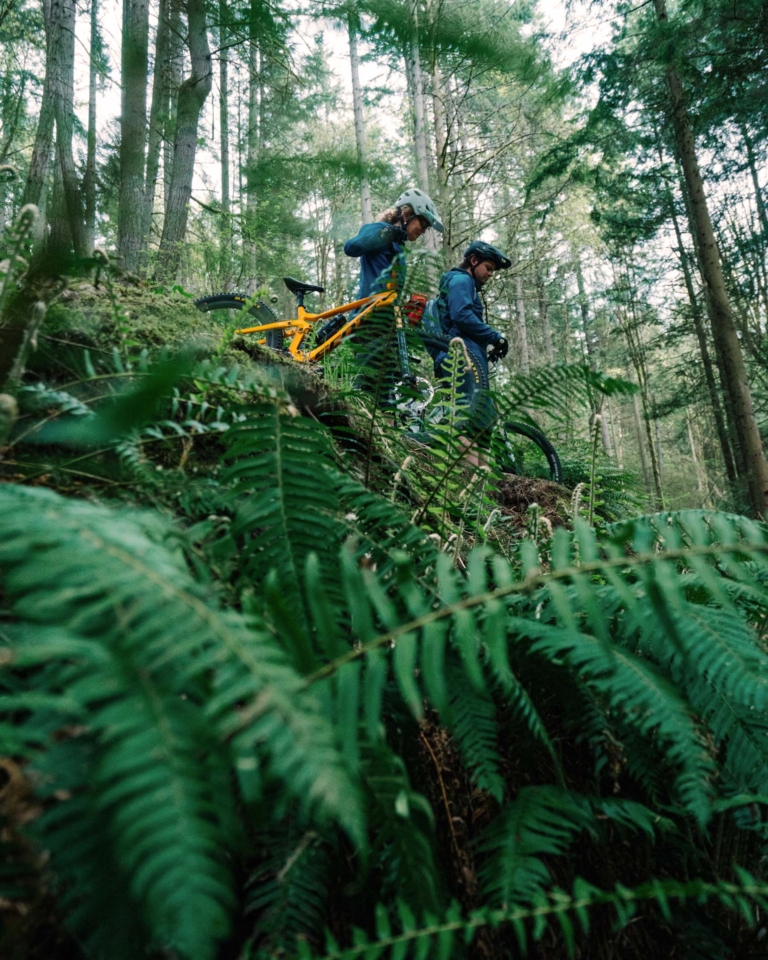
Most moms keep walks with their kids; Betty and Hayden session double-black diamonds, which has become somewhat of a family unit tradition after 2 decades of riding together. Female parent and son telescopic the final rock roll on Empress before dropping in. Photo: Jordan Manley
Every bit a newly single mom, Betty worked overseas flights on weekends while Hayden stayed with his dad or grandmother, and she'd return for bedtime on Sundays. "You simply kind of adapt as you keep," she says. "I just reinvented gamble. Instead of going mountaineering or stuff like that, we'd get car camping with my parents, and it was just and so fantastic."
Betty's face glows when we talk about anything mom-related. She asks to see photos of my own kids and swoons at the sight of them. In a higher place the stairway in her home is a huge sheet photo of her and Hayden effulgent later on a day of cat skiing together.
"Mountain biking was the perfect activity for a single mom because it was right outside our door and easy for [me and] Hayden to do together," she says. "I would pick him up after schoolhouse and we'd dash over to Fromme for a ride."
Hayden remembers her enthusiastic coaching and patience on the trail. At an age when almost kids desire their parents to park around the corner to avoid being seen by their friends, Hayden welcomed his mom joining him and his friends on rides. "It's amazing when you become on a technical trail with her," he says. "She just zips forth like you wouldn't believe. She'd be better than my buddies, and then that was a funny dynamic."
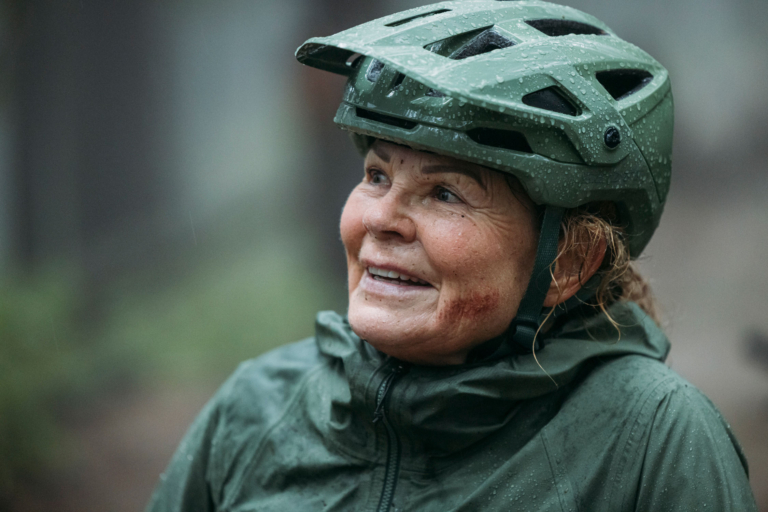
There's a price for riding someplace equally high consequence as the North Shore, and it's one paid in smashes, scuffs and oftentimes broken bones. On this particular afternoon, neither the weather nor a bruised jaw could wipe the smiling off Betty's face equally she sessioned the black-diamond Pingu trail on Mount Seymour. Photo: Travis Rummel
Permit me just say that if my mom were mountain biking solitary down double-black diamonds, I would probably give her a tracking device or an emergency buoy. Simply Betty isn't my mom. And I'k not Hayden. "My business concern for my mom is overridden by knowing she is so experienced," he says. "She is the consummate mountain woman."
Most people, however, notice her age before her ability. Occasionally, when she comes up on fellow riders assessing stunts on the trail, "they see I'm older, and I'g a adult female, so they just stay in the mode because they think I'1000 not going to exist able to ride information technology. I just say, 'Excuse me, I think I'1000 going to ride on through.' I really like that because I experience like I'k doing a service for women—older people, as well, but particularly for women."
Merely with all sports, injuries happen. Similar that time she broke her leg difficult-boot snowboarding. Or when she bankrupt both her hands riding the infamous "Rippin' Rutabaga" rock drop in the Whistler Mount Bike Park.
"I retrieve lying on the ground," she says. "I was 54 then, and I knew I was injure badly, but I didn't desire to tell the bicycle patroller how old I was."
Hayden was fifteen at the time and returned home to witness his female parent immobile from the shoulders downward. "She had these crazy wrapped arms, lobster hook things," he says, "and she couldn't practice anything."
At age 58, Betty took early on retirement and started her ain landscaping concern, where she continues to assist her friends and neighbors maintain their yards. It's a job she doesn't need; she just loves the work. However, it too means she more often than not rides lone: Most of her bicycle buddies work during the week, and Betty avoids riding on weekends (the trails are also decorated, she says).
And, of class, she still rides with Hayden whenever he'due south home. Hayden now lives in Revelstoke, British Columbia, and whenever he talks most his mom, he's visibly proud. "For me, she's laid the path that I've followed in my life, and it's a unlike path than a lot of people," he says. "But she's always been the biggest supporter and inspiration."
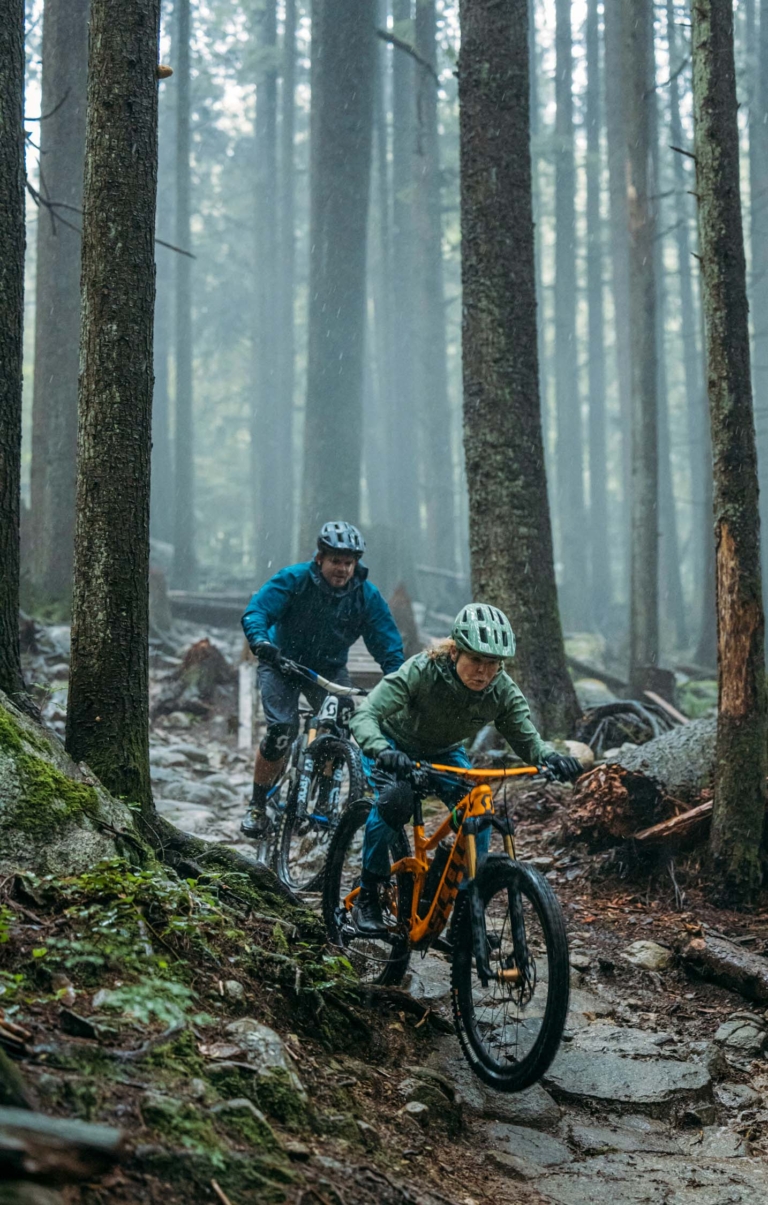
In a place that can receive 100 inches of precipitation each year, you get used to riding in the pelting; after 30 years, Betty actually enjoys it. Betty and Hayden navigate roots and the weather on lower Pingu—just another lovely mean solar day on the North Shore. Photo: Travis Rummel
Almost 30 years after her first lap downwards Executioner, Betty admits she's scaled back her riding (she avoids skinnies in particular), enlightened that a bad crash could have larger consequences than when she was younger. But she all the same sends. Not because she's fearless. She but knows better.
"It is calculated," she says. "You know your limits. Sometimes you push a lilliputian bit too much and y'all get away with it. But you know your limits, and you lot know what you want to do."
Back in the fall storm, we call it a day and say our goodbyes. As I pull out into the pouring rain, I'm left with an overwhelming sense of permission to effort all of those things I'd convinced myself I was too old for. I'm not crumbling out of the fun and games of my early 30s; after a day with Betty, I feel similar the good times are merely offset.
"When I was 50 years quondam, I never thought I'd be able to ride a mountain cycle fast down a trail at 73," she says. "It'southward interesting how your perception of historic period changes equally you get older. I would love to exist 65 again. Isn't that crazy? Who would have ever thought. The biggest thing I've learned is to appreciate where you lot are."
Author Contour
Source: https://eu.patagonia.com/gb/en/stories/north-shore-betty/story-119987.html
0 Response to "Shore to the Mountain and Back Again"
Post a Comment