The Causes Behind the Rise of Abstraction in Art
Abstract fine art is a multi-faceted genre that comes in a diverse range of forms. The ambiguity and lack of objective representation inherent in abstruse art has made it catchy for many to understand.
Hither, The Artling brings you the definitive guide to agreement abstruse art, where we discuss the primal ideas and characteristics behind it, the rise of diverse abstruse movements since the late 19th century, and why information technology continues to exist such a popular art genre. Proceed reading to learn more nigh why to incorporate abstruse art into your art drove, and how to narrow downward your selection.

Zao Wou-Ki, 28.02.67, 1967.
Image Courtesy of Christie'due south
What Defines Abstract Art?
Abstruse art is a wide and varied artistic approach that has influenced diverse movements over the course of history. Abstruse art tin can be defined as painting, sculpture, photography, pattern, or any art class that does not objectively nor accurately represent visual reality. Abstraction directly opposes figurative fine art and annihilation that direct delineates a subject field or object. Artists renowned for conceiving new abstract techniques or using abstraction in dynamic ways over the last century include Wassily Kandinsky, Piet Mondrian, Mark Rothko, Helen Frankenthaler, and Zao Wou-Ki.
Since the early 1900s, abstraction has formed an integral pillar in mod and contemporary fine art. Today, abstract art continues to be explored in multifarious ways, with many artists expanding and developing this ever-evolving genre.
What are the Ideas Behind Abstruse Art?
Rather than focusing on the truthful depiction or realistic fake of an object, abstract art looks at othernon-objective creative elements of shape, form, color, and line. Abstract techniques accept been used by artists to explore ideas across the canvas and our physical reality. Abstraction is often seen to acquit a moral dimension – a notion that was particularly prevalent in the tardily 19th and 20th centuries, where ideas of spiritualism, purity, and gild informed many artists and their work. Pulling away from literal and representational art, abstract art is an escape from reality and is vastly open to estimation.
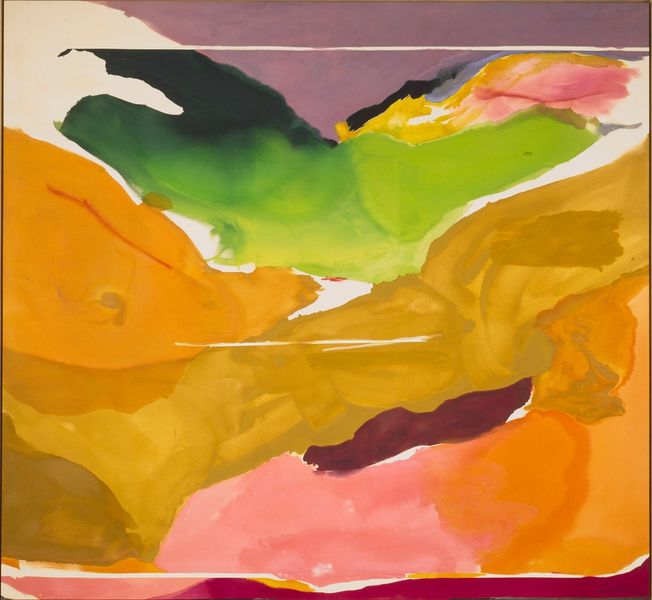
Helen Frankenthaler, Nature Abhors a Vacuum, 1973.
Paradigm Courtesy of Helen Frankenthaler/Artists Rights Lodge (ARS), New York — via National Gallery of Art, Washington.
What are the Characteristics of Abstract Art?
A main and fundamental aspect of abstract fine art is that imagery is non-representational. However, it should exist noted that 'non-representation' can be slight, partial, or consummate. Abstract fine art is a spectrum, just take a await at the different forms it can be presented in stylistically: from Surrealist dream-similar works past Salvador Dali, the Neoplastic works of Piet Mondrian, to Jackson Pollock's energetic Abstract Expressionist paintings.
Brainchild has been explored and expressed by artists in a plethora of ways, the large number of abstruse movements that have adult over the last century simply showcases how vast and open up-ended the genre is. Hence, we tin simply sympathize the specific characteristics of abstruse art when looking at specific movements and styles. This will be further elaborated upon in the adjacent department.
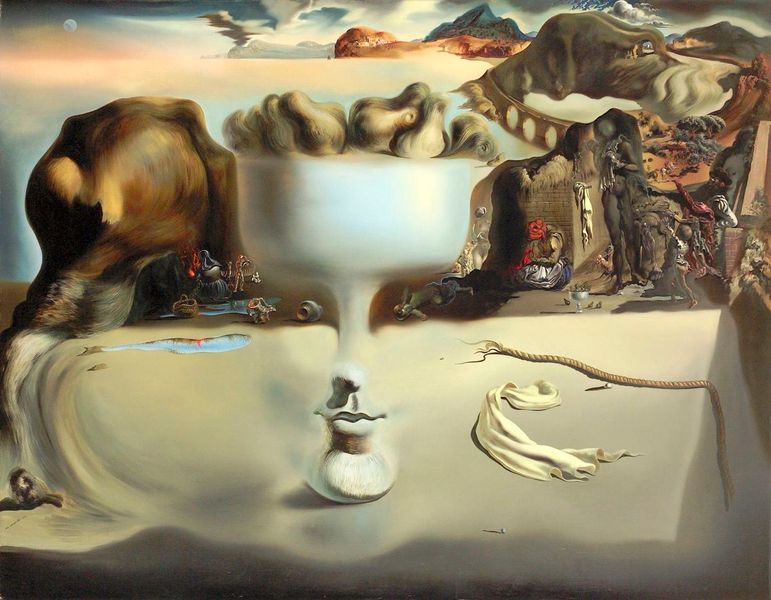
Salvador Dali, Apparition of Face and Fruit Dish on a Beach, 1938.
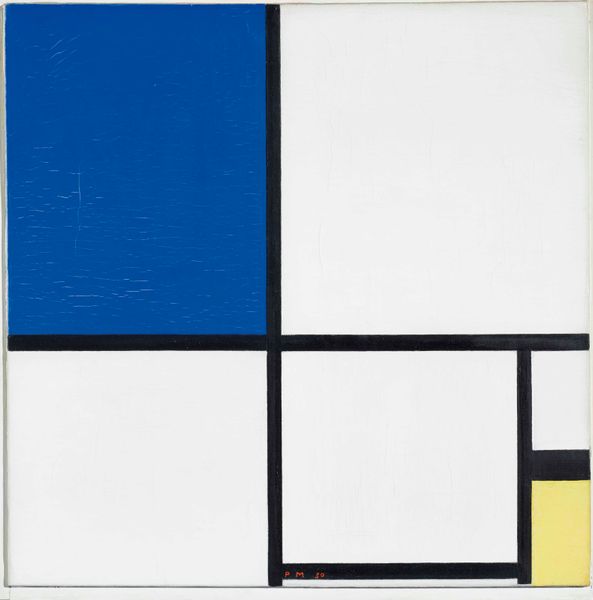
Piet Mondrian, Limerick No. II with Blueish and Yellow, 1930.
Prototype Courtesy of Christie's
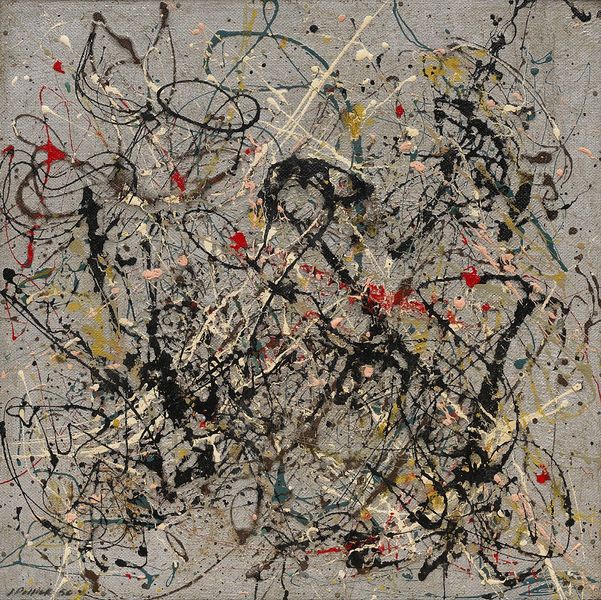
Jackson Pollock, Number 18, 1950.
Image Courtesy of © 2018 Pollock-Krasner Foundation : Artists Rights Society (ARS), New York.
When was Abstract Art Most Popular?
Abstract art has existed even as early on as the Tang dynasty (618 - 907). Yet, the rise of abstract art movements merely really came in the belatedly 19th century when artists began to deviate from classical and traditional modes of painting every bit a result of growing feelings of cynicism and disillusionment that followed WWI. Arguably, such tendencies towards abstraction began with the Impressionist movement, which reinforced the notion that fine art could be non-representational and less objective. The motion afterward saw the development towards more abstract depictions, which was evident in Cubism and Fauvism.
By the turn of the 20th century, instead of replicating objects from the real earth, artists began to paint abstract ideas derived from their own minds and imagination. Many placed precedence on the formal qualities of their piece of work over the actual field of study matter and visual accurateness of the painting itself. German Expressionist artist Wassily Kandinsky has been regarded as the pioneer of abstruse art and 1 of the kickoff to truly encompass completely abstract compositions. His bright, dynamic, and colorful pieces take been described to represent the globe through emotion and expression. Kandinsky besides incorporated his involvement in music into his vividly colored paintings and would frequently use musical terms to describe his works, such as "lyrical", "improvisations", and "compositions".

Wassily Kandinsky, Composition 8, 1923.
Image Courtesy of © 2018 Artists Rights Club (ARS), New York:ADAGP, Paris
What are the Different Types of Abstract Fine art?
Expressionism
Expressionism was one of the offset abstract art movements to come into prominence in the 20th century. Marc Chagall, Paul Klee, and Wassily Kandinsky were notable expressionist artists who used gestural markings, an intense color palette, and non-naturalistic brushwork to create bold and sometimes mystical abstract landscape pieces. Images produced placed emphasis on the artist's inner feelings over replicating reality.

Paul Klee, They're Biting, 1920.
Prototype Courtesy of Tate
Cubism & Fauvism
Cubism and Fauvism were ii 20th century art movements that had a stiff influence on another. These unlike artistic styles showcased the world in a distorted or fragmented manner, which was during that time, was a revolutionary arroyo in representing reality. Cubism sought to represent the world through geometric and fragmented shapes rendered beyond a two-dimensional flick plane. Fundamental cubist artists includePablo Picasso and Georges Braque.
Fauvist fine art on the other hand was characterized by strong brushwork, separate applications of non-naturalistic colors, with forms delineated in a simplified and abstract manner. Fauvists were largely associated with the scientific color theories that were developed in the 19th century, which explains why many works were executed with vivid and bold complementary colors. Henri Matisse and André Derain were some of the nigh influential artists who promoted fauvism in their work.
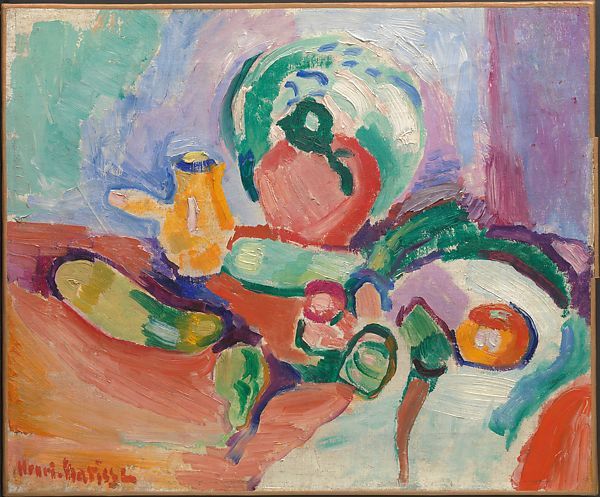
Henri Matisse, Still Life with Vegetables, 1905.
Image Courtesy of MET Museum
Neoplasticism
Neoplasticism, also known as De Stijl, is a Dutch art motion that was developed presently afterward the outbreak of WWI. Information technology is a style of abstract painting pioneered by Mondrian that sought to reproduce reality in its purest course. Going far beyond aesthetic considerations, Neoplasticism non only addressed the social and political anxieties brought about by the state of war, just it was likewise imbued with the philosophical and religious ideas of theosophy. It was a style that proposed that brainchild could explicitly illustrate the human mind through purely geometric forms and primary colors.

Piet Mondrian,Composition C (No. III) with Reddish, Yellow and Blueish,1935.
Abstruse Expressionism
Abstract Expressionism is an American art move that developed following WWII. Works of this style are ofttimes characterized by potent, thick,and gestural brushstrokes and active marker-making. Abstract expressionists tend to fall under two groupings, the first is action painters, and the 2d is referred to as color field painters.
Artists such as Jackson Pollock and Joan Mitchell became widely recognized for their 'action paintings', in which spontaneity and improvisation played an important office of the fine art-making process. Frequently, the canvass would exist taken off the easel, laid on the floor and large quantities of paint would exist splattered onto the canvas using powerful and emotive brushwork.
Other abstract expressionists took a different approach. Mark Rothko and Clyfford Nevertheless, known as color field painters, created simple compositions by filling an entire sheet with blocks of singular colors. Artists like Rothko believed that his canvases attained spiritual and divine qualities, and were able to produce emotional responses from viewers. Color field painters focused on the aesthetic, textural, and abstract elements of the painting.

Joan Mitchell, Ladybug, 1957.
Image Courtesy of MoMA
Why is Abstract Art so Popular?
Abstract art, blueprint, and architecture can be institute everywhere – it is all around us, and considering of the unlimited means information technology can be explored, information technology is understandable why this popular genre has formed a major office of a lot of artistic practices today.
The employment of abstract techniques has enabled artists to explore and represent their personal thoughts and feelings without the need for directly representation. Brainchild paved the way for artistic freedom, where annihilation from spirituality, materiality, to psychological and mental states, could be explored through the imaginative application of color, line, and course.
The popularity and attraction of abstruse art is largely due to the fact that it is an incredibly versatile genre that continues to evolve till this 24-hour interval. With the rising of technology, social media, digital applications, and tools, we are already seeing abstract art developing and taking new shape.
Why Collect Abstract Art?
Abstract art makes wonderful additions to whatever drove for their timelessness and infinite appeal. Abstract works are great alternatives to figurative and more representational pieces that may direct allude to a specific narrative. What makes abstract fine art and then versatile is that it is open up to estimation, and at the aforementioned time can be extremely meaningful and emotive.
What are the Qualities of Adept Abstruse Art?
When in search for the perfect abstract piece of work, there are a few essential factors that y'all need to take into consideration to ensure that you lot are selecting a piece of work of impeccable quality. Non only is it of import to collect work that is visually appealing to you, but there are other more technical elements to expect out for before making that decisive buy.
Art is very subjective, just there is such a matter as 'adept' and 'bad' art. When browsing through abstract artworks, quite oft the 'representational' elements and discipline matter of the piece rest in the awarding of materials and the formal qualities of the piece of work. Hence, it is vital to take into consideration the Colors used by the artists. The apply of complimentary colors that raise each other is extremely important, it showcases the mastery and technical ability of the artist.
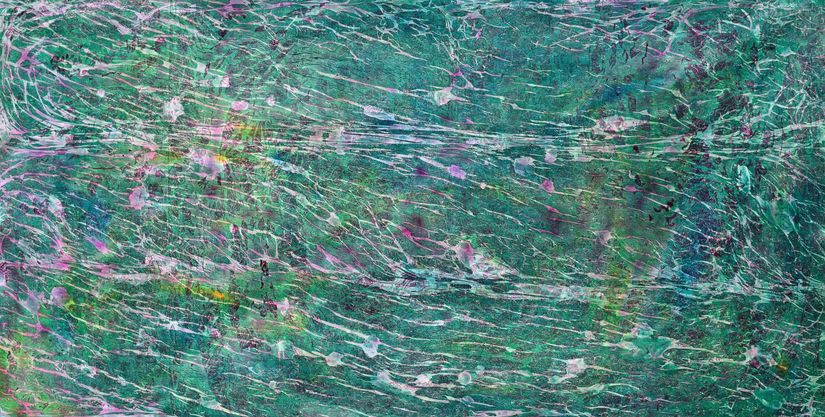
Sumit Mehndiratta, Electra // Available on The Artling
Skill and technique are integral when examining a good abstruse work. These tend to be highlighted in the textures, both visually and physically in the slice. Dimensionality, layering, thick impastos, skilled brushwork quite often create hitting and visually alluring works. Paying attention to the splatters, the markings, the composition, and the movement and flow all add to the uniqueness of the work.
Perhaps the near important quality in proficient abstract art is the culmination of all visual elements that evokes a sure emotion from the viewer. Think about how the piece of work makes y'all experience, does the work accept some grade of meaning behind it? A work is worth investing in when y'all can see the artist's personality in the piece and makes you lot feel something – it does not thing if information technology is positive or negative. Good abstract art should have melancholia furnishings upon the viewer.
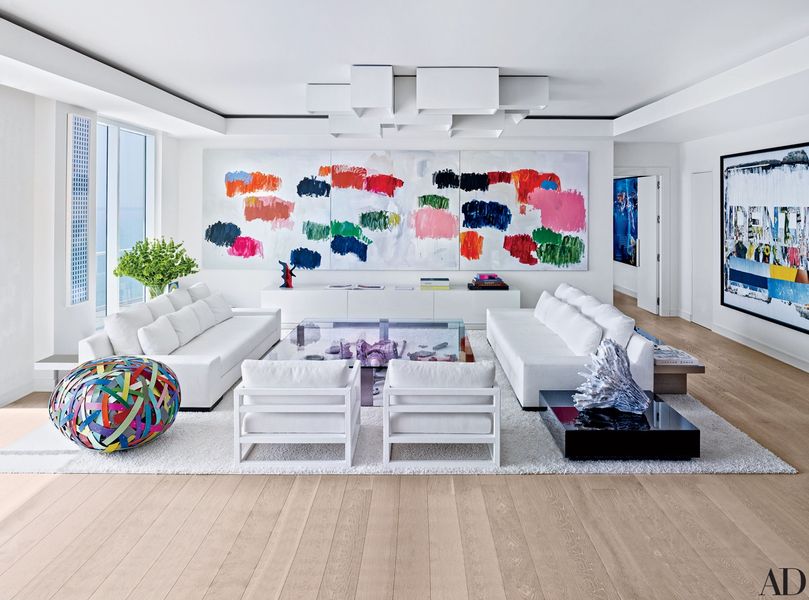
View of Jorge Pérez's living room in Florida, featuring a vibrant and large abstract painting
Image Courtesy of Architectural Digest
Abstruse Art for Home Décor
Decorating your home with abstract art can help to raise and build the desired temper inside your living space. Depending on the color of the work and type of abstract piece you lot select, it tin really arm-twist an emotional response and connection when people come into the space. Abstract works are keen ways to introduce color to the living surface area, you tin can too employ these pieces to enhance other materials and textural elements in the room.

View of Frank Stella's, The Pequod Meets the Delight, at LinkedIn's San Francisco Office
Image Courtesy of Business Insider
Abstract Fine art for the Workspace
Many offices and corporate workplaces choose to decorate their spaces with abstruse art. This is considering abstruse fine art can create a profound impression on a viewer – even if it is not explicitly pointing to something specific. Abstract works allow people the liberty to assign their own significant to the work, whilst having a dramatic touch on on that individual. Such pieces can form a sense of dynamism and energy within the office space that is reflective of the company'southward style and core values. Abstruse paintings or murals are also nifty ways to fill up vast and empty wall spaces. They can certainly breathe life into the room.
Abstruse Art on The Artling
Discover a varied pick of abstract artworks by some of the finest and established artists from all over the world, right here on The Artling!

A Fine Line - Tay Bak Chiang (Bachelor on The Artling)

Dark-green Quill - Tay Bak Chiang (Available on The Artling)

Particle 170531 - Yongsun Jang (Available on The Artling)

Particle SN120429 - Yongsun Jang (Available on The Artling)

Shape Shifter - Leelee Chan (Available on The Artling)

Late Night - Leelee Chan (Available on The Artling)

Dinner Time - Kazuhiro Higashi (Available on The Artling)

Phantom - Kazuhiro Higashi (Available on The Artling)

Birds I - Farnaz Jahanbin (Bachelor on The Artling)

Curve Line vii - Farnaz Jahanbin (Available on The Artling
Whatsoever views or opinions in the post are solely those of the authors and do not necessarily stand for the views of the company or contributors.
Source: https://theartling.com/en/artzine/abstract-art-buyers-guide/
0 Response to "The Causes Behind the Rise of Abstraction in Art"
Post a Comment