what should you ask to determine if a source is reasonable?
7.five Evaluating Sources
Learning Objectives
- Know how to ascertain if the information a source offers is relevant to your topic and current enough to utilize.
- Cover whether information is objective, reasonable and accurate.
- Understand how to determine if a source is apparent.
Returning to Jacoba'south project, we can see that each blazon of genre she might use to write her essay on Social Security volition require unlike questions to enquire, sources to pursue, testify and support to use.
| Genre | Informative Essays | Interpretive Essays | Persuasive Essays | Problem-Solving Essays |
|---|---|---|---|---|
| Questions to ask | What are the present facts nigh Social Security and its solvency? | What has Social Security meant to American history, civilization, politics, and government? | Should Social Security be saved or phased out? | Assuming it's worth saving, how can we preserve Social Security in a way that doesn't put united states of america in more debt? |
| Types of sources | Government budget figures, projections, and reports | Historical records from the 1930s forward | Editorials and position papers from policy experts and recall tanks | Articles and book-length works on financial policy and authorities entitlements |
| Evidence and support | Demographics, actuarial tables, and economic statistics | Political speeches and advertisements, congressional and presidential records | Arguments from Social Security proponents and opponents | Policy recommendations and proposals |
The more Jacoba reflects on the kind of research she wants to spend her time conducting and the kind of writing she'south most comfortable doing, the better off she'll be.
When you evaluate a source, you need to consider the 7 core points shown in Figure 7.2.
Figure 7.2
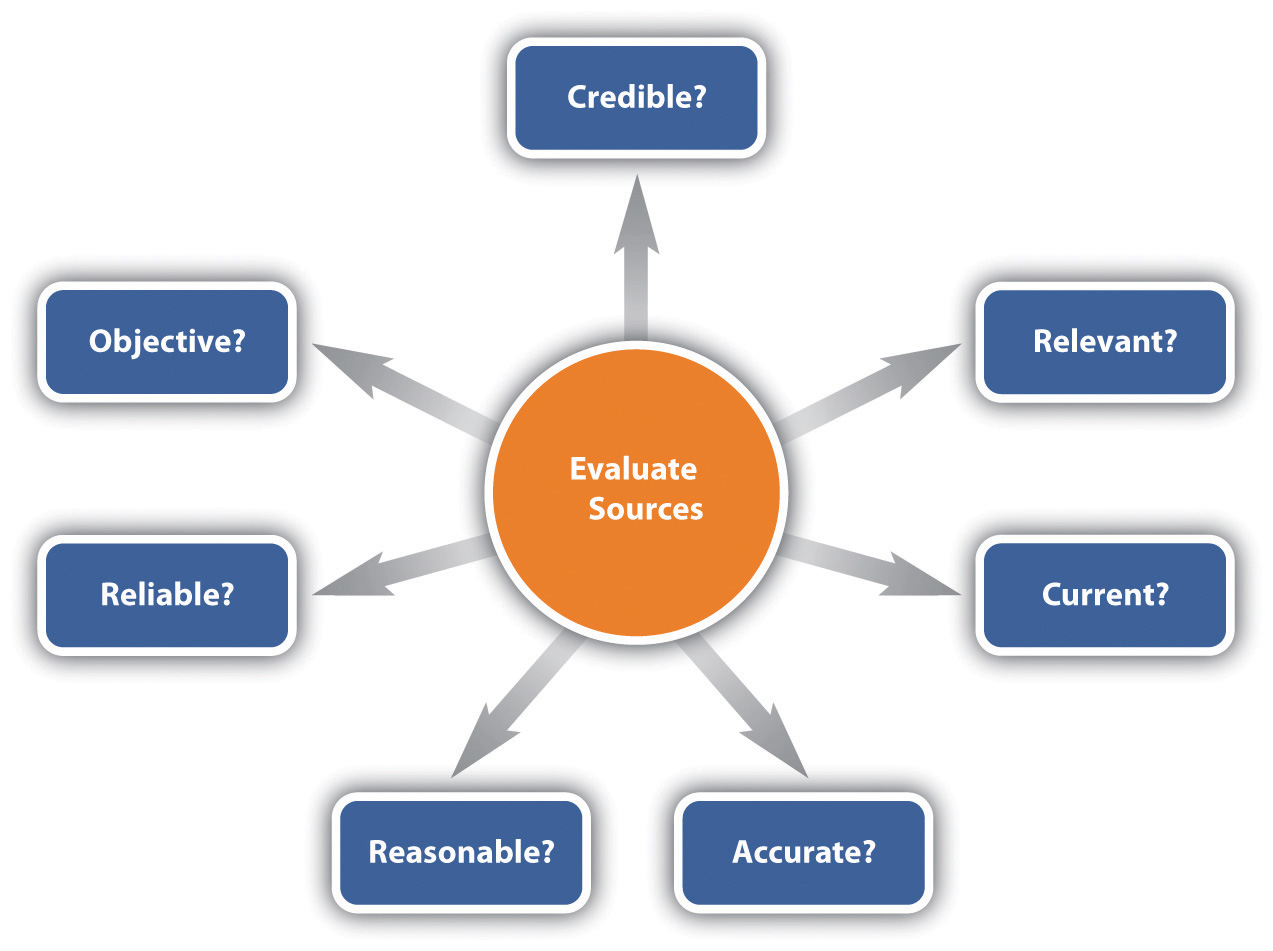
A source is relevant if it tin contribute to your newspaper in a meaningful mode, which might include any of the following:
- Supplies support for core argument(southward)
- Adds a sense of authority to your argument(due south)
- Contributes background information
- Provides other viewpoints
- Offers definitions and explanations that your audience will need for clarification
When determining if a source is electric current enough to utilize, a general rule of thumb is that a source must be no more than than ten years erstwhile. In some situations, very few sources exist that were published within the last ten years, so older sources can be used as long as yous explain why the employ of the older sources is acceptable and meaningful. Or mayhap y'all may be using older sources to establish a historical record of thoughts and statements on your issue in question.
Before you utilise a source, yous need to satisfy yourself that the data is accurate. In impress sources, you can use the author (if known) and the publisher to help y'all make up one's mind. If you think the author and publisher are legitimate sources, then you are probably prophylactic in assuming that their piece of work is accurate. In the case of online information, in add-on to considering the author and publisher, you can expect at how long agone the site was updated, if show is provided to support statements, and if the information appears to be thorough. For either impress or online sources, you can cheque accuracy by finding other sources that support the facts in question.
You can deem a source to be reasonable if it makes overall sense as you read through it. In other words, use your personal judgment to make up one's mind if you lot think the data the source provides sounds plausible.
Reliable sources do not show biasPrejudice or a nonobjective opinion. or conflict of interestA state of affairs where a person or system might personally do good from his, her, or its public actions or influence. . For example, don't choose a toy company's site for data about toys that are best for children. If you are unsure about the reliability of a source, cheque to see if it includes a listing of references, so track down a sampling of those references. Likewise, check the publisher. Reliable publishers rarely involve themselves with unreliable data.
A source is objective if information technology provides both sides of an argument or more than one viewpoint. Although you tin can apply sources that exercise not provide more than one viewpoint, y'all demand to balance them with sources that provide other viewpoints.
| .edu | Educational |
| .com | Commercial, for-turn a profit, business |
| .gov | Government |
| .mil | Military |
| .cyberspace | Network |
| .org | Not-for-profit arrangement |
A credible source is i that has solid backing by a reputable person or organization with the authority and expertise to present the information. When you haven't heard of an author, you can often judge whether an writer is credible by reading his or her biography. If no biography is available, you tin can research the author yourself. You tin besides judge the credibility of an online source by looking at accost extensionThe concluding three letters in an Internet accost (e.g., .com and .edu). . Equally a rule, you need to be aware that .com sites are commercial, for-turn a profit sites that might offer a biased viewpoint, and .org sites are likely to have an calendar. Accept precautions not to be fooled by an accost extension that y'all call back would belong to a credible source. Always retrieve and read critically so you aren't fooled.
Cardinal Takeaways
- A source is relevant to your topic if information technology supports your argument, adds a sense of authority to your statement, contributes background information, provides a different viewpoint, or offers central knowledge the audience volition demand. As a full general rule, unless you are working with a subject that requires some historical research, a source should be no older than x years.
- Information within a source needs to be authentic, reasonable, reliable, and objective. Authentic means that the facts are correct, reasonable means information technology makes basic sense to yous, reliable means it is without bias or conflict of interest, and objective ways it presents more than than 1 viewpoint.
- A source is credible if the source has the expertise to nowadays the information.
Exercises
- Choose a research topic of interest to y'all. Notice ane source that is both related to the overall topic and relevant to your specific topic. Draw the relevant role the source could brand (support, authority, groundwork, viewpoints, or knowledge). Find a second source that is related to the overall topic but not as relevant to your specific topic.
- Find a source that you think is not acceptable due to not being accurate, reasonable, reliable, or objective. Share the source with your classmates and explain why you lot accept deemed the source as unacceptable.
- Choose a research topic of involvement to you. Find two sources with information that chronicle to your topic—one that is credible and i that is not credible. Explain what makes i apparent and the other not credible.
Source: https://saylordotorg.github.io/text_handbook-for-writers/s11-05-evaluating-sources.html#:~:text=You%20can%20deem%20a%20source,the%20source%20provides%20sounds%20plausible.
0 Response to "what should you ask to determine if a source is reasonable?"
Post a Comment